EU survey: rising concerns push demand for more European action
The results of the latest Eurobarometer survey


- A majority of European citizens is worried about security and safety issues, such as active conflicts (72%), terrorism (67%), natural disasters made worse by climate change (66%), cyber-attacks (66%) and uncontrolled migration (65%).
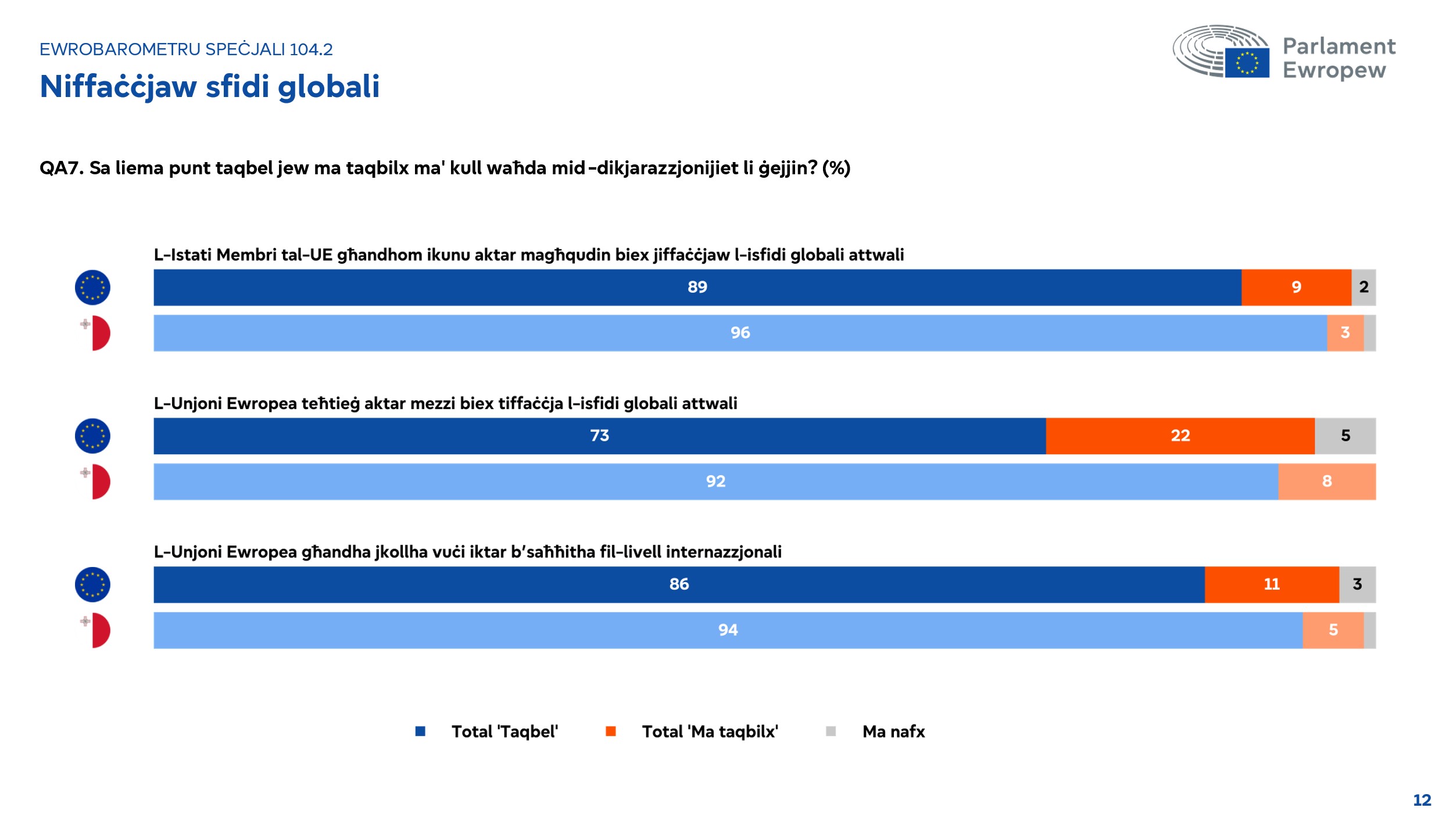
- 89% of respondents say that EU member states should be more united to face these global threats.
- 86% want the EU to have a stronger voice and 73% want more EU resources to tackle threats at international level.
- In Malta, 71% consider EU membership positively, an increase of 12% on the previous survey, and 81% would like to see the EU take a bigger role in protecting its citizens against global crises and security risks.
At a time of heightened geopolitical tensions, citizens are increasingly anxious about their future and want the EU to act with unity and ambition.
The results of the European Parliament’s latest Eurobarometer survey, published on Wednesday, show that global developments instil a sense of worry in EU citizens. Geopolitical turbulence is having a major impact on Europeans’ perceptions, with the majority (52%) saying they are pessimistic about the future of the world, 39% that they are pessimistic about the future of the EU and 41% that they are pessimistic about the future of their country. The outlook appears brighter on an individual level, with over three-quarters of Europeans (76%), and up to 85% in Malta, optimistic about their own future and that of their family.
The challenges are many, as the survey findings confirm. Worries relating to security and safety are high across all topics tested, with the following concerns topping the list: conflicts near the EU (72%), terrorism (67%), cyberattacks from non-EU countries (66%), natural disasters worsened by climate change (66%), and uncontrolled migration flows (65%). In parallel, communication-related risks, such as disinformation (69%), hate speech online and offline (68%), fake content generated by artificial intelligence (68%), insufficient data protection (68%), and threats to freedom of expression (67%), are also widely felt causes for concern.
Such concerns are also reflected in Malta. In relation to security-related concerns, uncontrolled migratory flows (81%) and cyber attacks from non-EU countries (80%) are the most pronounced. In communication-related issues, the top concerns for Maltese respondents were disinformation (78%), fake content through AI (79%), hate speech, data protection (both at 76%), and threats to freedom of speech (73%).
Call for a united Europe
Against the backdrop of numerous challenges, EU citizens want the European Union to step up its game. Sixty-six per cent of citizens - and 81% in Malta - want the EU to participate in keeping them safe, underlining the protective role of the EU in the current political context. Citizens also reckon that unity is crucial: 89% of respondents EU-wide, and 96% of the Maltese, say that EU member states should be more united whilst 73% - and 92% in Malta - agree that the European Union needs greater means to face current global challenges. To strengthen its position in the world, the EU should focus primarily on defence and security (40%), competitiveness, economy and industry (32%), and energy independence (29%), according to citizens. For the Maltese the main priorities are defence and security (32%), education and research (30%), and climate action and reduction of emissions (24%).
“Geopolitical tensions shape Europeans’ daily sense of security. Citizens expect the European Union to protect, be prepared and act together. That is exactly what a stronger and more self-assertive Europe must deliver. Europe is our strongest shield,” said European Parliament President Metsola.
Cost of living a key priority
High prices continue to impact citizens' standard of living. Domestically, inflation, rising prices and the cost of living (41%) are once again the top priorities that Europeans want the European Parliament to address. This is also the top priority for Maltese respondents (40%), followed by public health (38%), the environment and climate change (34%), and migration (33%). At EU level, the economy and job creation follow closely at 35%, whereas in Malta 24% make these a priority.
While most respondents expect their standard of living to remain stable over the next five years, a substantial share (28%) anticipate a decline, especially in countries where economic uncertainty is more acutely felt. The expectation that their standard of living will fall is strongest among French (45%), Belgian and Slovak citizens (both 40%). In Malta, 26% think their standard of living will increase, 46% say it will not change, while 26% think it will decrease. At European level, citizens expect the EU to focus on strengthening its position in the world, notably by focusing on defence and security (40%, up by 3 percentage points compared to the last survey).
Citizens meanwhile reaffirm the importance of fundamental and founding values. Peace emerges as the value they most want the European Parliament to defend (52%), reflecting the current geopolitical climate. Democracy (35%), freedom of speech (23%, human rights (22%), and the rule of law (21%) also remain central expectations.
Growing support for EU membership
Attitudes towards the EU and its institutions remain positive despite small declines since May 2025. A relative majority holds a favourable image of the EU (49%, -3pp), with only 17% a negative. 38% (-3pp) have a positive image of the European Parliament versus only 20% a negative. A strong and growing majority of citizens think that their country’s EU membership is a good thing (62%), a two-point increase since the question was last asked in February/March 2024.
Seventy-one percent of Maltese respondents think EU membership is a good thing while 22% are neutral in their assessment. Furthermore, 77% would like to see the European Parliament play a more important role.
From a sociodemographic angle, young people continue to be among the most fervent supporters of the EU and have high expectations regarding its role. Young citizens, aged 15 to 30, are more likely than older citizens to see the EU and Parliament in a positive light: 58% have a positive image of the EU (compared with 49%-43% among older age groups) and 68% want a stronger role for the European Parliament (compared with 58%-54%). There is also very strong support among younger Europeans for: more unity among Member States in the current context (90%), more means for the European Union (78%) and a stronger EU voice at international level (87%).
The full results can be found on the Eurobarometer website.
Background
The European Parliament’s Autumn 2025 Eurobarometer survey was carried out by Verian research agency between 6 and 30 November 2025 in all 27 EU member states. The survey was conducted face to face, with video interviews (CAVI) used additionally in some Member States (Cyprus, Denmark, Finland, Malta, Netherlands and Sweden). A total of 26 453 interviews were conducted. The EU results were weighted according to the size of the population in each country.